
Call for Papers: Protecting Human Rights: Duties and Responsibilities of States and Non-State Actors
octubre 4, 2011
Tiene muy buena pinta. Suerte con las propuestas.
Jornadas sobre “La protección de los bienes jurídicos globales” en la UAM
septiembre 29, 2011
Los días 24 y 25 de noviembre de 2011 celebraremos las Jornadas 2011 del Anuario de la Facultad de Derecho de la Universidad Autónoma de Madrid (AFDUAM) sobre “La protección de los bienes jurídicos globales”, que este año dirijo junto a mi admirado colega y amigo Francisco Garcimartín. Aquí pueden ver un programa de las Jornadas. 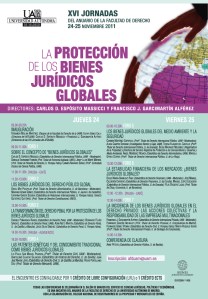
La idea central de las Jornadas es esta:
La paz, la justicia, la libertad, la salud, el medio ambiente y el desarrollo sostenible, el conocimiento, la dignidad humana o la seguridad pueden ser considerados bienes jurídicos globales. Estos bienes, como en el caso de los bienes públicos globales, deben ser capaces de producir beneficios a través de las fronteras, las poblaciones e incluso las generaciones. La protección jurídica de ese tipo de bienes ha sido hasta ahora una responsabilidad primordial del Estado y ha tenido lugar fundamentalmente dentro de las estructuras del Estado y en sus relaciones con otros Estados sobre la base del derecho internacional. Sin embargo, los Estados han dejado de tener un monopolio exclusivo sobre los intereses y acciones relativos a la protección de los bienes jurídicos globales. Hoy se impone un modelo pluralista en el que los gobiernos, las instituciones y los actores no estatales coexisten en los procesos de protección y producción de bienes jurídicos globales. Las Jornadas de 2011 del AFDUAM tienen como objeto plantear una discusión abierta sobre los bienes jurídicos globales desde perspectivas diversas de derecho público, privado y también de filosofía jurídica y política. Para concretar ese objeto, siguiendo la estela de las investigaciones sobre bienes públicos globales, se pretende hacer confluir en la discusión aportaciones descriptivas y críticas sobre tres tipos de deficiencias, que se conocen como déficits normativos, de jurisdicción y de participación. En efecto, la protección de bienes jurídicos globales crea la necesidad de enfrentarse a grandes desafíos normativos que requieren respuestas de un derecho global, que ofrezca soluciones a la laguna normativa que se genera en los espacios donde el derecho nacional e internacional no alcanza a regular o lo hace de manera insuficiente. El déficit de participación se manifiesta en el hecho de que vivimos en un mundo de múltiples actores donde la cooperación y el conflicto relativo a los bienes jurídicos globales ocurren fundamentalmente en un nivel intergubernamental. El déficit jurisdiccional se revela en la paradójica divergencia entre el mundo sin fronteras en que operan o deberían operar los bienes jurídicos globales y el poder inmenso de las fronteras nacionales como factores determinantes en la protección de dichos bienes.
Si están en Madrid y les interesa el tema, los esperamos en la UAM para conversar sobre la protección de los bienes jurídicos globales. La asistencia es libre, pero no se olviden de inscribirse, porque el espacio es limitado.
Este post ha sido publicado también en el blog del proyecto de investigación sobre bienes jurídicos globales.
Call for Papers and Panels: «International Law and the Periphery»
septiembre 2, 2011
Here is an interesting Call for Papers and Panels for the join Sydney/AUC Conference on «International Law and the Periphery» in Cairo, Egypt, on 16-18 February 2012. Good luck with your proposals!
One year on from the “Arab Spring”, join us in Cairo to explore contemporary geographies of international law. you are invited to reflect anew upon the “cores” and “peripheries” of international legal knowledge and practice in the face of recent structural shifts. where (if anywhere) are they located today? does international law project a disciplinary periphery, or several? who or what occupies international legal peripheries today and what does peripheral status imply? what may be at stake in the mapping of cores and peripheries? Are there cores in the peripheral and vice versa? to what extent, if at all, do core-periphery dynamics in international law channel development and reform? long associated with dependency theory, world systems theory and geographical analyses of trade, core-periphery schematics have nonetheless informed international legal thought, argument and policy-making in a wide range of ways. this conference will enable scholars of law and related disciplines to revisit core-periphery dynamics in global governance, in both their symbolic and their material dimensions, and contribute to their re-imagining for the current age.
Co-hosted by the American University in Cairo law department and Sydney law School at the University of Sydney, this conference will afford both established and emergent scholars working in or around the international legal field an invigorating opportunity to explore the foregoing theme.Keynote addresses will be made by:
- Professor Arjun Appadurai, Goddard Professor of Media, Culture, and Communication at new york University (confirmed); and
- Professor david Kennedy, director of the Institute for Global law and Policy and Professor of law at harvard law School (tBC).
Submissions of proposed conference presentations and/or panel proposals are warmly invited. those wishing to present papers at the conference should submit abstracts in English of no more than 200 words, together with a brief statement outlining their institutional affiliation(s) (if any) and contact details, to peripheryconference@gmail.com by 30 September 2011. those who would like to propose a panel (comprised of three speakers) should do so at the same time.
Limited ground transportation and all conference catering, materials and activities will be covered by the host organisations. In addition, a limited number of modest stipends may be available to conference speakers on the basis of financial need; please indicate at the time of submission if you would like to seek this assistance. Unfortunately, however, no funding is available to support conference participants’ travel to Cairo. Any questions may be directed to Fleur Johns or thomas Skouteris at fleur.johns@sydney.edu.au and tskouteris@ aucegypt.edu, respectively.
Por si es de interés para algún lector del blog, difundo esta convocatoria para presentar propuestas de artículos.
Call for Papers
Post- Crisis International Financial Regulation: Fragmentation, Harmonization and Coordination
The challenges of the 2008 financial crisis were severe and prolonged. The international regulatory community struggled to contain, manage and respond to the crisis despite a fragmented and complex set of regulatory sources and an unclear path to coordination let alone harmonization. Still, the urgency brought on by the crisis forced a degree of cooperation and sparked a hope that greater cooperation could emerge amongst the world regulators going forward. As the world emerges from this crisis, whether the ability or desire to forge greater cooperation exists is less than clear.
The International Economic Law Interest Group (IEcLIG) of the American Society of International Law (ASIL) will host a special Research Forum in early December 2011 to discuss the complexities international financial regulation post crisis. The conference will take place at Suffolk Law School on December 2, 2011. We invite the submission of proposals in the form of abstracts of no more than 300 words which will address this topic. Here is an illustrative list of potential topics, although you should feel free to submit any paper topic relevant to this field of study.
•Financial Innovation and Regulatory Competition
•Transparency and Systemic Risk
•The Rise of the New Global Executive Coordination: The Case of G 20
•The Basel III: A Glass Half-Full or Half-Empty?
•The Fall of Intergovernmentalism in International Financial Regulation: The Rise of the Government Network
•The Development Dimension of International Financial Regulation
•Is the Macro-Prudential Coordination Possible?: Recent Challenges and Responses
•Multiple Stakeholders and Financial Regulation: Relationships Between Governments, Society and Business
•Regulatory Coherence and Regulatory Sprawl
•Relationship between International and National Regulatory Bodies
Abstracts should be emailed to Sungjoon Cho at scho1 (at) kentlaw.edu and Claire Kelly at claire.kelly (at) brooklaw.edu by August 30, 2011. Each submission should include the author’s name, institutional affiliation, contact information and e-mail address. Selected papers will be announced by October 15, 2011. Working drafts should be submitted by November 25, 2011 to be circulated among the forum participants. Presenters will be exempted from the forum fee. A limited number of partial stipends to help cover travel costs may be available to help defray travel and accommodation costs.
Call for Papers: The EU in International Affairs III
julio 27, 2011
Copio otro call for papers, esta vez sober la UE en los asuntos internacionales. Buena suerte para los que presenten propuestas.
CALL FOR PAPERS: Deadline 30 September 2011
‘The European Union in International Affairs III’
Brussels, 3-5 May 2012
The Institute for European Studies at the Vrije Universiteit Brussel (IES-VUB), the Institut d’Études Européennes at the Université Libre de Bruxelles (IEE-ULB), the United Nations University Comparative Regional Integration Studies (UNU-CRIS) and Egmont – the Royal Institute for International Relations invite papers for the third edition of the ‘European Union in International Affairs’ (EUIA) Conference (formerly organised in the context of GARNET).
The multidisciplinary EUIA Conference will provide a forum for discussion and exchange of ideas among the growing number of scholars that take an interest in understanding the role of the EU in the world in diverse policy fields (including environment, energy, information society, freedom and security, finance, security and defence etc). This includes the debate concerning the EU as an international actor and the dynamic interplay between the EU, its member states, other regions and external partners in a multipolar/multilateral world. It may include topical issues such as the European response to the upheavals in the broader Middle East, European foreign policy post-Lisbon, the external effects of the Eurozone crisis, the EU’s role in global governance and the international implications of the return of nationalism as a political force on the European continent. Similarly, attention to the external implications of internal EU developments such as the push towards a (Digital) Single Market and creation of the space of freedom and security are welcomed.
The EUIA Conference will be open to all relevant disciplines and sub-disciplines, including international and European law, international political economy, economics, political science, international relations and history. It will also continue to foster exchange between the scientific and the policy communities, especially through keynote addresses by senior policy makers and a number of policy-link events featuring academics as well as policy makers.
Deadline for paper proposals: 30 September 2011
Notification of acceptance: 13 January 2012
Submission of full papers to chairs and discussants: 16 April 2012
Please submit your paper abstract (300 words) according to the instructions on the conference website at http://www.ies.be/conference2012, accessible from 1 September. Proposals for entire panels of a maximum of four speakers are welcome but papers are subject to the standard review process and the organisers may amend panels accordingly. In addition to the standard procedure for individual paper submissions, a list of paper authors and titles in each panel should be submitted by email to conference@ies.be.
Limited travel grants (‘Solidarity Grants’) will be available to cover part of the cost of participation of junior researchers from disadvantaged countries. Details will be available on the conference website, which will also contain further relevant information, including registration fee, etc.
The EUIA Conference Organisers: IES-VUB, Egmont, UNU-CRIS, IEE-ULB.
Master en Diplomacia y Función Pública Internacional
julio 11, 2011
La Fundación Centro de Estudios Internacionales (del MAEC, la UB y La Caixa) lanza el Master en Diplomacia y Función Pública Internacional, título propio interuniversitario de la UB, la UAB y la UPF, para el próximo curso 2011-2012. Es un Master de vocación profesional, con dos trimestres de formación intensiva en Barcelona y un semestre de pràcticas en OOII, Embajadas, Consulados, Misiones Permanentes, grandes corporaciones y otros destinos. Pueden encontrar más información aquí.
Call for Applications
“The vices and virtues of international constitutionalism”
European University Institute, PhD Training School
It is hereby announced that a three-day doctoral training school shall be held at the European University Institute, Florence, on October 20-22, 2011, in context of COST Action 1003.
The topic of this training school will be “the vices and virtues of international constitutionalism”, and submissions are invited from PhD students working in areas related to this topic who are interested in debating the topic with fellow PhD students and with internationally recognised experts in the field of international constitutionalism.
The doctoral training school is intended to bring PhD students from different European countries together on topics related to COST Action 1003, International Law between Constitutionalisation and Fragmentation: the role of law in the post-national constellation. (to be found at the Action website: http://www.il-cf.eu/ ). Support can be offered to PhD students from participating countries. Currently the following countries participate in the Action: Austria, Belgium, Czech Republic, Denmark, Finland, France, Germany, Greece, Israel, the Netherlands, Norway, Poland, Portugal, Spain, United Kingdom, Former Yugoslav Republic of Macedonia, Hungary, Ireland, Sweden and the European Institute in Florence. Serbia, South Africa and Australia are currently applying for partnership.
Topic
Two recent tendencies have shaped recent discourses on international constitutionalism. On one side, the expansion of international law to areas never touched before has put into question the legitimacy and ability of international law in managing subjects that belonged previously to states. On the other side, international law is fragmenting into functionally separated regimes, challenging the unity and coherence of international law. This has prompted scholars to apply a constitutionalist reading of international law as an attempt to impose order, e.g. via the construction of legal hierarchy and the prioritization of certain values. Critics, however, have pointed at possible pitfalls and dangers of a constitutionalist reading of international law, including the risk of imposing specific values – e.g. Western, democratic, capitalist – and a particular understanding of order, to the detriment of those who beg to differ. Consequently, the feasibility of the further development of international constitutionalism warrants examination.
Set up
The school will last for three days.
On the first day, senior experts in the field of international constitutionalism from international law and international relations will present and discuss their work with the PhD candidates. Core topics on the first day will be: the promises and pitfalls of domestic analogies, constitutionalism and the politics of legalism, constitutionalism, liberalism and hegemony, and the use of constitutional language in debates on the responsibility to protect. So far we have confirmations from the following speakers:
Dr. Veronika Bilkova (Law Faculty of the Charles University and Institute of International Relations in Prague), Dr. Catherine Van de Heyning (University of Antwerp) Dr. Sarah Nouwen (Cambridge University), Dr. Nikolas Rajkovic (Austrian Academy of Sciences), and Prof. Dr. Wouter Werner (VU University Amsterdam).
The second and third day will be devoted to the research of the PhD candidates themselves. PhD candidates present their work, and will receive detailed feedback from senior scholars and fellow PhD students.
Financial support
Participants can apply for financial support to attend the PhD training school.
Application
PhD candidates are invited to discuss the constitutionalism debate, with a focus pitfalls and/or promises constitutionalist readings of international law.
Submissions will be accepted until September 1st, 2011.
Submissions should specify:
- The basic outline of the PhD project (max. 500 words)
- How the PhD projects fits in COST Action 1003 as well as in the general topic of the PhD training school (max. 500 words)
- Whether financial assistance is required. Please specify the amount requested.
Applications will be prioritized according to their relevance and closeness to the topic of the training school and the research agenda of the Action.
For any queries or to submit complete applications, please contact one of the following two coordinators:
Ciaran Burke, ciaran.burke@eui.eu or
Alexis Galan, alexis.galan@eui.eu.
Convocatoria de artículos: Principios UNCTAD sobre otorgamiento y toma responsables de préstamos soberanos
junio 30, 2011
CONVOCATORIA DE ARTÍCULOS
Conferencia de las Naciones Unidas sobre Comercio y Desarrollo
y
Universidad Autónoma de Madrid
Madrid, 2 de Marzo de 2012
Principios de la UNCTAD sobre otorgamiento y toma responsables de préstamos soberanos
ANTECEDENTES DE LA CONFERENCIA
Las causas y los efectos negativos generalizados de la crisis global financiera y económica impulsaron a la UNCTAD a poner en marcha en 2009 una iniciativa para promover prácticas responsables en el otorgamiento y toma de créditos soberanos. El objetivo de la iniciativa de la UNCTAD es proveer de un foro para el debate sobre las prácticas responsables y desarrollar una serie de principios comunes aceptados y prácticas relativas a cuestiones de deuda pública.
Para contribuir con el proceso de redacción de estos Principios fue establecido un grupo de expertos. El grupo está compuesto por expertos en Derecho y Economía de renombre internacional, inversores privados y ONGs. Representantes de alto nivel del FMI, el BM y el Club de París participan en calidad de observadores del grupo. Tras varias reuniones formales e intercambios de ideas, surgió este proyecto de Principios. Los Principios están disponibles en árabe, chino, español, francés, inglés y ruso en http://www.unctad.info/en/Debt-Portal/News-Archive/Our-News/UNCTAD-Launches-Principles-on-Responsible-Sovereign-Lending-and-Borrowing-3052011/
Dado que este borrador está concebido como un punto de partida para la discusión internacional y que será sometido a los gobiernos para observaciones adicionales, la UNCTAD y la UAM (mediante sus Facultades de Derecho y Ciencias Económicas, y con el apoyo del proyecto DER2009-11436 sobre bienes jurídicos globales) organizarán una conferencia para analizar en profundidad las bases, implicaciones y perspectivas de los Principios y los problemas que se proponen resolver.
El otorgamiento y toma de préstamos soberanos requiere una aproximación interdisciplinar y pluralista. Por ese motivo, la conferencia favorecerá la discusión entre académicos y expertos provenientes de diferentes disciplinas y contextos, con intereses en cuestiones económicas, financieras, jurídicas e institucionales. Las investigaciones originales e innovadoras son bienvenidas teniendo en cuenta que los Principios son novedosos en varios sentidos.
La conferencia tendrá lugar en el campus de la UAM el viernes 2 de marzo de 2012. El programa preliminar estará disponible una vez que se haya hecho la primera selección de propuestas de ponencias. Las ponencias seleccionadas serán publicadas en un libro colectivo del que está prevista una versión en inglés y otra en español.
TEMAS DE LA CONFERENCIA
La Conferencia va a considerar los siguientes temas:
Económicos y Financieros
1) Los Objetivos de Desarrollo del Milenio y la crisis de deuda
2) Corresponsabilidad de los tomadores y prestadores como un nuevo concepto político y económico en las finanzas globales
3) Implicaciones económicas de los Principios en las distintas categorías de acreedores
4) Prevención de crisis de deuda y los Principios
5) Estados en desarrollo y desarrollados y los Principios
6) Mercados secundarios, agencias de evaluación de créditos y los Principios
7) Gestión de deuda y los Principios
8 ) Solución de crisis de deuda y los Principios
Jurídicos e institucionales:
1) Naturaleza jurídica de los Principios
2) La relevancia del derecho comparado y los Principios
3) Los principios vistos desde el derecho privado, el derecho público y el derecho internacional
4) Comparación con otras iniciativas similares
5) Implementación de los Principios
6) Las Naciones Unidas y la arquitectura financiera global
PROCESO DE SELECCIÓN
Expertos y académicos de todas las categorías, incluyendo candidatos a obtener el grado de doctor, están invitados a participar. Las ponencias serán seleccionadas sobre la base de los resúmenes enviados por los autores para ser considerados en el proceso de selección. Los criterios de selección son: originalidad del trabajo en relación con los temas de la conferencia y equilibrio geográfico de los expositores. Sólo se aceptará un resumen por persona. Los resúmenes no deben exceder las 500 palabras. El trabajo propuesto debe ser original e inédito.
Los trabajos podrán ser presentados en inglés o español. La Conferencia ofrecerá un servicio de traducción simultánea. Sin embargo, los autores que presenten sus trabajos en español deberán entregar una versión escrita en inglés si desean que sus trabajos sean considerados para la publicación en inglés.
Además del resumen con la propuesta, debe incluirse la siguiente información:
- Si fuese posible, indicar el tema de la conferencia al que se refiere el resumen
- Nombre del autor y afiliación institucional
- Un breve CV del autor, que incluya una lista de publicaciones relevantes
- Datos de contacto del autor, incluyendo dirección de email y teléfono.
Las propuestas y la información adicional deben enviarse a unctad-principles@uam.es. Cualquier solicitud de información sobre la Conferencia puede ser enviada a esa misma dirección. Para mayor información sobre la iniciativa de la UNCTAD, por favor visitar http://www.unctad.info/en/Debt-Portal/
CRONOGRAMA
- El plazo para presentar propuestas vence el 4 de octubre de 2011.
- Los autores seleccionados recibirán confirmación en la dirección de correo electrónico provista antes del 25 de octubre de 2011.
- Los autores seleccionados deberán entregar un borrador de su presentación antes del 31 de enero de 2012.
- La Conferencia tendrá lugar en Madrid el 2 de marzo de 2012.
- Las versiones finales para publicar deben ser entregadas antes del 30 de marzo de 2012.
COSTES
Todos los expositores seleccionados podrán registrarse gratuitamente en la conferencia.
La organización cubrirá los costes de viaje y hotel para los 12 expositores seleccionados.
CALL FOR PAPERS
UNITED NATIONS CONFERENCE ON TRADE AND DEVELOPMENT
AND
UNIVERSIDAD AUTONOMA DE MADRID
Madrid, 2 March 2012
UNCTAD’s Principles on Responsible Sovereign Borrowing and Lending
BACKGROUND OF THE CONFERENCE
The causes and widespread negative effects of the global financial and economic crisis prompted UNCTAD to launch an initiative in 2009 to promote responsible sovereign lending and borrowing practices. The purpose of UNCTAD’s initiative is to provide a forum for debate on responsible practices and to develop a set of commonly accepted principles and practices relating to sovereign financing.
An expert group was established to contribute to the process of drafting these Principles. The group is composed of world renowned legal and economic experts, private investors and NGOs. Senior representatives from the IMF, the World Bank and Paris Club participate as observers of this group. After several formal meetings and exchanges of ideas a draft of the Principles emerged. This document is available in Arabic, Chinese, English, French, Russian and Spanish at http://www.unctad.info/en/Debt-Portal/News-Archive/Our-News/UNCTAD-Launches-Principles-on-Responsible-Sovereign-Lending-and-Borrowing-3052011/
As this draft is intended to be a point of departure for international discourse and will be subject to further discussions with governments, UNCTAD and the UAM (through its schools of Law and Economics, with the support of the project DER2009-11436 on ‘global legal goods’) will organize a conference to discuss in depth the foundations, implications and perspectives of these Principles and the problems they are designed to address.
Since sovereign lending and borrowing require an interdisciplinary and pluralist approach, the conference will encourage discussion among scholars and experts from different disciplines and backgrounds, focusing on economic, financial, institutional and legal issues. The UNCTAD’s initiative being novel in several ways, original and innovative research is especially encouraged.
The conference will take place in the campus of the UAM in 2 March 2012. The preliminary program will be available online as soon as the first selection of papers has been processed. Papers selected will be published in a collective book, one edition in English and another one in Spanish.
TOPICS OF THE CONFERENCE
The conference will explore these themes:
Economic and Financial Topics
1) Millennium Development Goals and debt crisis
2) Co-responsibility of lenders and borrowers as a new political and economic concept in global finance
3) Economic implications of the Principles on each category of creditors
4) Debt crisis prevention & the Principles
5) Developing and developed countries & the Principles
6) Secondary markets, credit rating agencies & the Principles
7) Debt management & the Principles
8) Debt crisis resolution & the Principles
Legal and Institutional Topics
1) Legal nature of the Principles
2) The relevance of comparative law & the Principles
3) The Principles seen from public, private and international law
4) Comparison with other similar initiatives
5) Implementation of the Principles
6) The United Nations and global financial architecture
APPLICATION PROCEDURE
Senior and junior scholars (PhD students included) and experts are invited to participate. Papers will be selected on the basis of abstracts submitted. Selection criteria are: originality of the work links to the conference theme, and geographical representation of the speakers. Only one abstract per author will be considered. Abstracts must not exceed 500 words. The piece must be original and unpublished.
The papers can be presented in English or Spanish. The conference will provide for simultaneous interpretation into English. However, authors presenting in Spanish who wish to be considered for the English edition of the book must supply a publishable English version of their papers.
In addition, the following information must be provided:
- If possible, the name of the topic for which the abstract is submitted;
- The author’s name and institutional affiliation;
- An author’s brief cv, including a list of relevant publications;
- The author’s contact details, including email address and phone number;
Proposals and additional information should be sent to unctad-principles@uam.es. Any enquiry about the conference can be directed to this same email account. For more information on the UNCTAD’s initiative please visit http://www.unctad.info/en/Debt-Portal/
TIMELINE
• The deadline for the submission of abstracts is 4 October 2011.
• Successful applicants will receive confirmation to the email account provided with the submission of the abstract by 25 October 2011.
• Accepted authors will be expected to submit a draft of their presentations by 31 January 2012.
• The conference will take place in Madrid in 2 March 2012.
• Final versions for publications should be submitted by 30 March 2012.
FINANCES
All selected speakers will receive free registration to the conference.
The organisation will cover expenses for travelling and accommodation for the 12 speakers selected.
I Congreso internacional UAM de Derecho de la Unión Europea
junio 21, 2011
El próximo 30 de junio vence el plazo para inscribirse en el I Congreso internacional de Derecho de la UE, organizado por la UAM, en el que se presentarán las Últimas tendencias en la jurisprudencia del TJUE (2008-2011). El CIDUE es una ocasión perfecta para analizar la jurisprudencia del Tribunal de Justicia de la Unión Europea. El programa es magnífico y está perfectamente enmarcado. En efecto, en la inauguración podremos escuchar una conferencia de D. Pascual Sala Sánchez, Presidente del Tribunal Constitucional, con una palabras previas de D. Gil Carlos Rodríguez Iglesias, antiguo Presidente del Tribunal de Justicia de la Unión Europea. La conferencia de clausura sobre “El diálogo entre jurisdicciones” estará a cargo de D. Pedro Cruz Villalón, Abogado General del Tribunal de Justicia de la Unión Europea, y D. Joaquín Huelin Martínez de Velasco, Magistrado del Tribunal Supremo, presentados por el Profesor de la Universidad de Salamanca, D. José Martín y Pérez de Nanclares. Se pueden inscribir aquí.




 aquiescencia