
ESIL Conference 2014 in Vienna: Call for Papers on «National Law as a Generator of International Law»
octubre 28, 2013

Gustave Klimt, Bauerngarten mit Sonnenblumen 1906. Österreichische Galerie Belvedere
The call for papers or posters for the ESIL Vienna Conference on 4-6 September 2014 includes:
Agora 2: National Law as a Generator of International Law
National law, both statutory and case-law, can influence international law in many ways. National law may serve as a template for treaties or lead to the development of customary law and, most importantly, national law may evidence general principles of law. Classic examples are the impact of the US Foreign Corrupt Practices Act on the OECD Anti-Bribery Convention or the Truman Proclamation’s influence on the customary international law of the continental shelf. A particularly fascinating role is played by domestic courts; their jurisprudence may take on a special law-making role as relevant state practice and, often at the same time, as opinio iuris evident in many immunity and extraterritorial jurisdiction cases.
This agora will address the various ways that national law and jurisprudence influence international law. What is the particular role of domestic courts? Does this role depend on national traditions? Is it shaped by transnational judicial dialogue or are courts in different states acting as isolated agents? How have international courts incorporated national law or national law concepts in their reasoning? How do international courts and tribunals ‘select’ the domestic case law on a particular matter?
The deadline for proposals for papers or posters is 15 January 2014.
ESIL Conference 2014 in Vienna: Call for Papers on International Law as a Generator of National Law
octubre 28, 2013

Gustav Klimt, Allee im Park vor Schloß Kammer 1912. Österreichische Galerie Belvedere
The call for papers or posters for the ESIL Vienna Conference on 4-6 September 2014 includes:
Agora 1: International Law as a Generator of National Law
International law has greatly expanded. Today, almost all spheres of life regulated by law are to some extent pre-determined by international law. Often international law even inspires national legislation that would otherwise possibly not exist at all. In some areas international law may substitute for domestic law. Global Law, Global Governance, Global Administrative Law and International Public Authority discourses debate whether international law or some modification of international law is likely to make domestic law superfluous in some areas or whether it may rather generate more domestic law. This agora is intended to focus on the role of international law in the domestic sphere. What are the quantitative and qualitative features of the influence of international law at the national level? Are the traditional concepts of incorporation/application still adequate? Are states still able to mediate and control the impact of international law? Is domestic social change through international legislation possible? Is it desirable?
The deadline for proposals for papers or posters is 15 January 2014.
ESIL Conference 2014 in Vienna: Call for Papers and Posters
octubre 27, 2013

Gustav Klimt, Kuss, 1907/1908 Österreichische Galerie Belvedere
The call for papers and posters for the ESIL Vienna Conference on 4-6 September 2014 has been published. The programme is magnificent and you can send proposals for papers or posters until 15 January 2014.
“INTERNATIONAL LAW AND …”
Boundaries of International Law and Bridges to Other Fields and DisciplinesInternational law has long been influenced by other fields of law and other disciplines and this conference will explore these influences and the way that they are intertwined. International law may regulate, mostly through treaties, other fields of law such as commercial, employment, family or environmental law; the use of international law is very different in each of these fields and international lawyers may be criminal lawyers, investment arbitrators or administrative law specialists while still considering themselves international lawyers. At the same time, international law needs to be understood in a broader context. The fluctuating content of international law – as a result of its decentralized norm-making process – and the various compliance and enforcement structures – due to the lack or weakness of centralized policing institutions – often require meta-legal reasoning when it comes to explaining the normative quality of international law and to understanding what the law is and why it should be followed. These trends have increased recently and threatened international law with fragmentation through over-specialization. In order to see the whole picture, international lawyers need to understand how international law is distinguished from and linked to other fields and disciplines.
The 2014 ESIL conference in Vienna will explore these interconnections and will also look at whether the boundaries of international law have been crossed, and in what ways. The title ‘International Law and …’ indicates that the focus is both on the interplay between international law and other fields of law and between international law and other disciplines.
The papers and posters will discuss international law and history, feminism, literature, films, sports, technology, et cetera.
The 2012 judicial practice of the International Court of Justice
octubre 26, 2013
 The third issue of the fourth volume of the Journal of International Dispute Settlement publishes a series of articles on the judicial practice of the International Court of Justice in the year 2012. The table of contents includes a juicy editorial by Tom Grant and a series of studies by Andrea Bianchi, Annemarieke Vermeer-Künzli , Andreas Zimmermann, Andre Nollkaemper, Sean Murphy, Geir Ulfstein, and myself. The latest American Journal of International Law contains the analysis of the 2012 judicial activity of the Court by Jacob Katz Cogan, the author of the useful ILR blog.
Homeland y la tenue sombra del derecho internacional
octubre 25, 2013

Foto: Kent Smith/Showtime
Homeland tiene un trasfondo lleno de reglas de derecho internacional. Por ejemplo, un aspecto central de la serie es un ataque con drones en Iraq, que mata al hijo del terrorista Abu Nazir y casi le cuesta la vida al protagonista Nicholas Brody. En la serie está presente siempre la tensión entre la expansión de las prerrogativas para la lucha contra el terrorismo y la protección de los derechos humanos, una tensión que define nuestra época con nitidez desde septiembre de 2001. En el cuarto capítulo de la tercera temporada la serie se traslada a Suramérica, porque el protagonista se encuentra atrapado en un edificio abandonado de Caracas, Venezuela, conocido como la Torre de David, al que el periodista John Lee Anderson le dedicó un ensayo en The New Yorker titulado ‘Slumlord‘, que ahora compara con los datos del capítulo de Homeland en su post ‘The Real Tower of David‘ y podrán corroborar quienes conocen esa parte de la ciudad. La ficción es atrayente, aunque la música que suena en el edificio, que proviene de una mezquita cercana en la serie de televisión, no resulta nada creíble.
Vacancies at the ICJ: Law Clerks to Judges of the Court
octubre 24, 2013
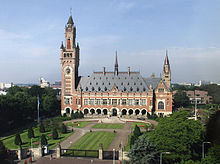 The International Court of Justice is seeking law clerks to Judges of the Court (Associate Legal Officers). The deadline for applications is 15 November 2013. The information is available here. Good luck!

Mapa de ataques digitales
octubre 23, 2013
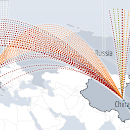
Google tiene un mapa de ataques digitales, que registra los ataques conocidos como DDoS (Distributed Denial of Service).
Call for Papers: IGILT and University of Tartu

Call for Papers
«The Approaches of Liberal and Illiberal Governments to International Law: A Conference Marking 25 Years since the Collapse of Communist Regimes in Central and Eastern Europe»
The University of Tartu and the European Society of International Law’s Interest Group on International Legal Theory (IGILT) invite submissions that will examine whether liberal (and illiberal) ideas make a difference in the context of international law along three general themes.
The conference will take place on June 12-13, 2014 at the University of Tartu History Museum, featuring keynote talks by José E. Alvarez (NYU) and Gerry Simpson (Melbourne). Due to a generous grant from the European Research Council, successful applicants will receive full scholarships to cover flight and accommodation costs, on the condition that they develop their presentation into an article of publishable quality and that they are ESIL members. Approximately ten articles from the conference will be selected for publication in the 15th volume of the Baltic Yearbook of International Law, which will be edited by Lauri Mälksoo and Ineta Ziemele.
INTERNATIONAL CONFERENCE ON «THE EUROPEAN UNION’S EXTERNAL ACTION IN TIME OF CRISIS» – 28/29 NOVEMBER
octubre 10, 2013
Una conferencia interesante en la Universidad de Granada.


The University of Granada, together with the ESIL Interest Group on the EU as a Global Actor, is organizing a Conference on ‘The European Union’s External Action in Times of Crisis’, which will take place on 28-29 November 2013 in the Granada Faculty of Law.
All members are warmly invited to participate in this Forum which will analyse the legal framework applicable to the European Union’s external action after the Lisbon Treaty, taking into account the experience of the last years.
Please, see here the conference programme: Granada Conference Programme
Further information is available at the website: http://www.dipri.org
It would be great to see you all in Granada.
Irene Blázquez-Navarro
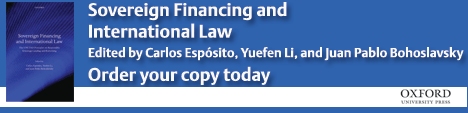
Sovereign Financing and International Law
septiembre 25, 2013




 aquiescencia