
Jeff McMahan: repensar la ‘guerra justa’
noviembre 13, 2012
No se pierdan el artículo del filósofo Jeff McMahan sobre la ‘guerra justa’ en las páginas del opinionator del NYT (se publica en dos partes, aquí y aquí). McMahan es autor de libros influyentes sobre la filosofía de la guerra, como The Ethics of Killing: Problems at the Margins of Life y Killing in War.
Bradbury, ciencia ficción y derecho internacional
junio 7, 2012
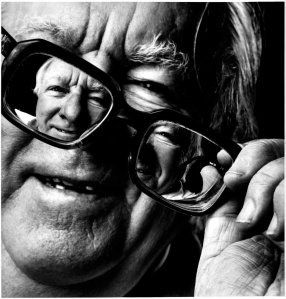
Ray Bradbury fotografiado por Michel Fainsilber
Nos dejó Ray Bradbury. No conozco ningún estudio de su obra en clave de derecho internacional, pero sería estupendo leer un ensayo de ese estilo. En realidad, como muestra el interés de algún curso reciente sobre derecho internacional y ciencia ficción, el tema es fascinante. En un mundo de drones, ataques cibernéticos y seres humanos ‘mejorados’ no hacen falta ejemplos adicionales a la realidad para sostener esta opinión, pero aquí va un botón de muestra: en la revista Wired, Clive Thompson hace referencia a un relato de Cory Doctorow donde se plantea la pregunta sobre las consecuencias que produciría la posibilidad de duplicar la propiedad física como un archivo MP3, si una sociedad pobre pudiera prosperar simplemente mediante copias piratas de coches, ropa o drogas para curar enfermedades mortales. ¿Les suena? Quizá tengamos que copiarle al profesor Francesco Francioni y hacer en nuestras universidades seminarios sobre derecho internacional y ciencia ficción para ver si nos ayudan a pensar mejor sobre las preguntas importantes sobre el derecho (internacional) y la justicia.
Anne Peters sobre los «Bienes jurídicos globales en un orden mundial constitucionalizado»
mayo 21, 2012
En nuestro sitio web del proyecto de investigación sobre bienes jurídicos globales hemos publicado un working paper de la profesora Anne Peters titulado «Bienes jurídicos globales en un orden mundial constitucionalizado». El texto será un capítulo del Anuario de la Facultad de Derecho de la UAM dedicado por entero a la protección de bienes jurídicos globales, que está en prensa y estará en las librerías en un par de meses.
No Citizens Here: Global Subjects and Participation in International Law, by Rene Urueña
abril 12, 2012
Bienvenido el nuevo libro de Rene Urueña: No Citizens Here: Global Subjects and Participation in International Law (Martinus Nijhoff, 2012). Rene es Profesor y Director del Área de Derecho Internacional, Universidad de Los Andes (Colombia) y está haciendo excelentes contribuciones al derecho internacional. Aquí va una breve descripción de su nuevo libro en inglés y castellano.
International legal scholarship has traditionally celebrated the possibility of individuals being considered as subjects of international law. This book challenges that narrative, and reveals hidden patterns in the way we think about legal subjects in global governance. Building on the notion of a risk society, this book argues that international law creates fragmented subjectivities, whose conflicting identities help perpetuate a certain global loss of sense that is characteristic of our times. An innovative contribution that draws on a wealth of international legal materials (including human rights, EU law, international economic law, and international organizations), this book is useful to those with an interest in international legal theory, new approaches to international law, global constitutionalism, and global administrative law.
Tradicionalmente, la posibilidad de que los individuos sean considerados como sujetos derecho internacional es celebrada como un avance – un objetivo que, si bien es difícil de alcanzar, es incuestionablemente positivo. Este estudio cuestiona esa narrativa. Propone que la fragmentación del derecho internacional genera subjetividades fragmentadas: una serie de identidades jurídicas incoherentes que contribuyen a perpetuar una cierta pérdida de sentido del individuo, la cual es característica de nuestros tiempos. Usando materiales de derecho internacional económico, derechos humanos, organizaciones internacionales y derecho comunitario europeo, este volumen será útil para aquellos interesados en la teoría del derecho internacional, constitucionalismo global, nuevas aproximaciones al derecho internacional y derecho administrativo global.
Muy recomendable.
¡Felicitaciones Rene!
ASIL-ESIL International Legal Theory Workshop Call for Papers
The International Legal Theory Interest Group of the American Society of International Law (ASIL), in partnership with the European Society of International Law (ESIL) Interest Group on International Legal Theory, will hold a joint works-in-progress workshop at the University of Cambridge’s Lauterpacht Centre for International Law on September 27–28, 2012.
The workshop’s theme is “Transatlantic Debates in International Legal Theory.” On many levels, the interaction between North American international legal scholarship and its European counterpart(s) is working very well. Time and again, however, one finds that the underlying theoretical or philosophical framework is radically different. In this workshop we would like to explore that difference without letting ourselves be defined by it. Contributions analyzing, criticizing, denying or celebrating the difference are welcome, as well as papers exemplifying the various theoretical approaches to international law, be they “American,” “European” or neither. The most important function of this workshop is to intensify the transatlantic theoretical debate by bringing together scholars with diverse disciplinary, philosophical, and methodological perspectives to discuss cutting-edge research on international legal theory.
Up to twelve papers will be selected for presentation. Although discussants will be assigned to introduce the papers, all workshop participants will be expected to read all of the contributions in advance and come prepared to contribute to the discussion.
Interested participants should submit an abstract (1,000 words maximum) summarizing the ideas they propose to develop for presentation at the workshop. Submissions on all topics related to international legal theory are encouraged, but preference will be given to proposals that engage the workshop’s theme. Papers that have been accepted for publication prior to the workshop are eligible for consideration, provided that they will not appear in print before the workshop.
The workshop’s organizers will undertake to secure outside funding to cover the costs of travel and accommodation for all scholars who present papers at the workshop, but they cannot, at this stage, guarantee its availability.
Abstract submissions should be sent to asil.esil.theory@gmail.com by April 20, 2012. Successful applicants will be notified by May 11, 2012. Papers must be fully drafted and ready for circulation to participants by August 31, 2012. Questions regarding the workshop may be directed to Evan Criddle (ecriddle (at) law.syr.edu) or Jörg Kammerhofer (joerg.kammerhofer (at) jura.uni-freiburg.de).
Jueces nacionales y la protección de bienes jurídicos globales humanitarios
noviembre 20, 2011
Junto con Nicolás Carrillo hemos publicado un estudio sobre «Los jueces nacionales como garantes de bienes jurídicos humanitarios» en el último número de la Revista Española de Derecho Internacional (2011). Aquí está el resumen:
Existen bienes jurídicos globales que protegen la dignidad humana que están recogidos por normas coincidentes del Derecho internacional y los ordenamientos jurídicos internos, en cuyo respeto está interesada la comunidad internacional. Los jueces internos de los Estados tienen la posibilidad de convertirse en garantes de dichos bienes jurídicos y de representar en consecuencia a una comunidad jurídica que trasciende a la estatal. Además, su interacción con diversas comunidades jurídicas transnacionales y su contacto mediato con las fuentes del Derecho internacional les permite influir en la determinación del contenido de dichos bienes jurídicos humanitarios y asumir un papel que trasciende al de meros garantes del Derecho internacional, convirtiéndose en actores del mismo. Diversos factores sociales, psicológicos y profesionales influirán en la posición que asuman los jueces al respecto, la cual a su vez estará condicionada por los límites y oportunidades ofrecidas en los Derechos internos que los revisten de autoridad.
La Constitución en 2020
septiembre 9, 2011
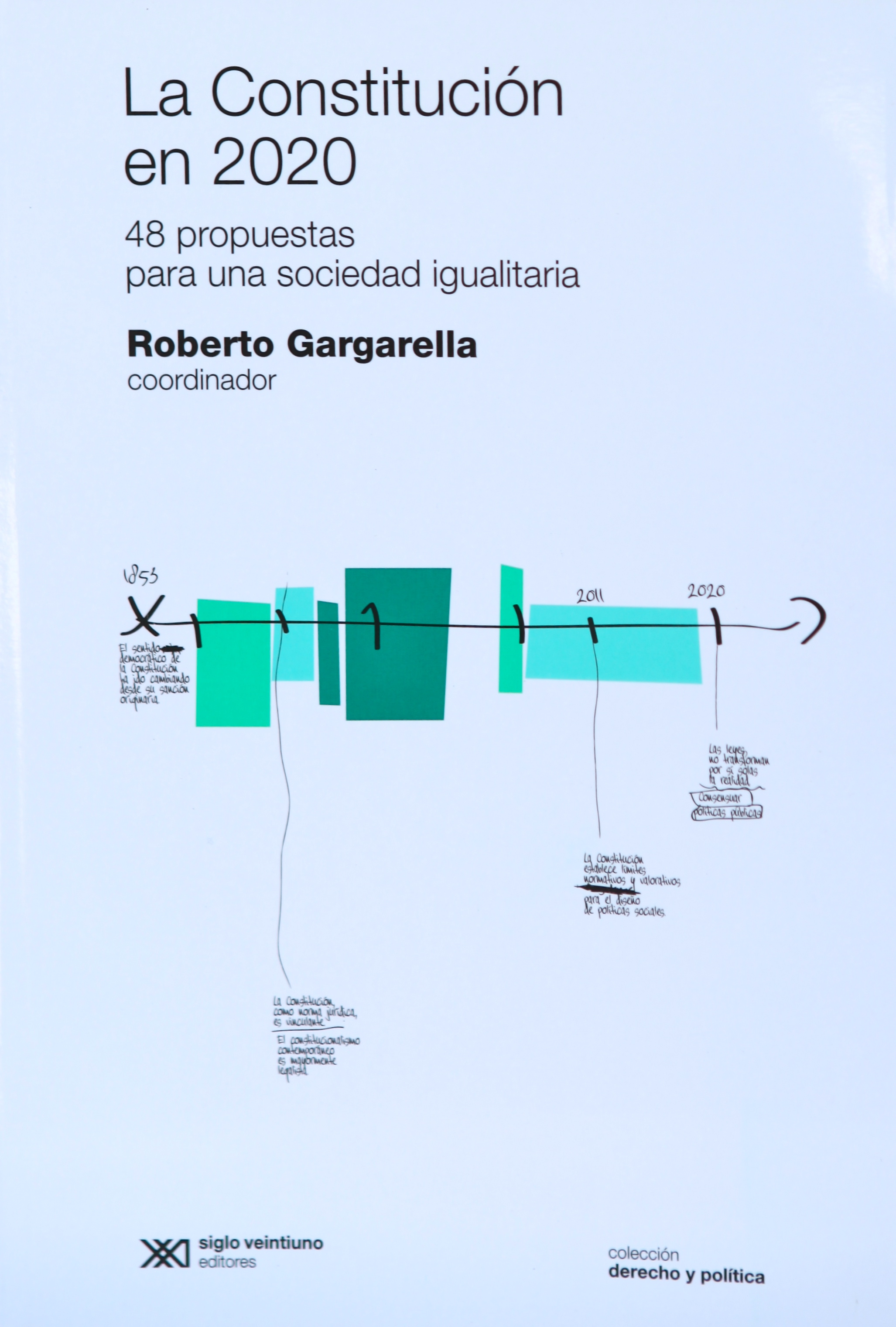
Desde hace unas semanas está publicada La Constitución en 2020. Les hablé con entusiasmo de este proyecto hace un tiempo (aquí), donde tengo una breve contribución. La portada es elegante, como pueden ver, y la edición de la editorial Siglo XXI está muy cuidada. Hay que agradecer, una vez más, a Roberto Gargarella la compilación exquisita de los textos, su poder de convocatoria para congregar a tantos autores y, sobre todo, su afán de impulsar proyectos igualitarios.
El texto de la contraportada dice así:
¿Si usted tuviera la posibilidad de sugerir, para los próximos años, la modificación de algún aspecto particular de la Constitución qué cambio sugeriría, y por qué razones?” En una experiencia inédita en la Argentina, el Centro de Estudios sobre Democracia y Constitucionalismo y la Facultad de Derecho de la Universidad de Buenos Aires convocó a una diversidad de especialistas a responder a esta pregunta, sometiendo a una mirada crítica a nuestra Ley Fundamental. Así nació este libro, que reúne casi cincuenta propuestas para repensar los derechos y la organización del poder que comparten dos rasgos centrales: una mirada inconformista frente al orden y la práctica constitucionales vigentes y la aspiración de un constitucionalismo más igualitario.
Inspirado en las preocupaciones y en la metodología del proyecto The Constitution in 2020, iniciado por los profesores Jack Balkin y Reva Siegel en la Universidad de Yale, pero sensible a las peculiaridades de nuestro contexto y trayectoria constitucional, La Constitución en 2020 es un ejercicio de aproximación que conjetura, a partir de novedosos y variados puntos de vista de autores excelentemente formados en el derecho público, qué debería decir la Constitución del futuro acerca de cuestiones como el principio de igualdad, el derecho de propiedad privada, los derechos previsionales y la seguridad social, los derechos ambientales, la libertad de expresión, la familia, la democracia, la representación y la participación política, el presidencialismo, la organización del Poder Judicial, el derecho de los pueblos originarios, los derechos humanos y la política criminal, entre muchos otros temas.
Call for Applications
“The vices and virtues of international constitutionalism”
European University Institute, PhD Training School
It is hereby announced that a three-day doctoral training school shall be held at the European University Institute, Florence, on October 20-22, 2011, in context of COST Action 1003.
The topic of this training school will be “the vices and virtues of international constitutionalism”, and submissions are invited from PhD students working in areas related to this topic who are interested in debating the topic with fellow PhD students and with internationally recognised experts in the field of international constitutionalism.
The doctoral training school is intended to bring PhD students from different European countries together on topics related to COST Action 1003, International Law between Constitutionalisation and Fragmentation: the role of law in the post-national constellation. (to be found at the Action website: http://www.il-cf.eu/ ). Support can be offered to PhD students from participating countries. Currently the following countries participate in the Action: Austria, Belgium, Czech Republic, Denmark, Finland, France, Germany, Greece, Israel, the Netherlands, Norway, Poland, Portugal, Spain, United Kingdom, Former Yugoslav Republic of Macedonia, Hungary, Ireland, Sweden and the European Institute in Florence. Serbia, South Africa and Australia are currently applying for partnership.
Topic
Two recent tendencies have shaped recent discourses on international constitutionalism. On one side, the expansion of international law to areas never touched before has put into question the legitimacy and ability of international law in managing subjects that belonged previously to states. On the other side, international law is fragmenting into functionally separated regimes, challenging the unity and coherence of international law. This has prompted scholars to apply a constitutionalist reading of international law as an attempt to impose order, e.g. via the construction of legal hierarchy and the prioritization of certain values. Critics, however, have pointed at possible pitfalls and dangers of a constitutionalist reading of international law, including the risk of imposing specific values – e.g. Western, democratic, capitalist – and a particular understanding of order, to the detriment of those who beg to differ. Consequently, the feasibility of the further development of international constitutionalism warrants examination.
Set up
The school will last for three days.
On the first day, senior experts in the field of international constitutionalism from international law and international relations will present and discuss their work with the PhD candidates. Core topics on the first day will be: the promises and pitfalls of domestic analogies, constitutionalism and the politics of legalism, constitutionalism, liberalism and hegemony, and the use of constitutional language in debates on the responsibility to protect. So far we have confirmations from the following speakers:
Dr. Veronika Bilkova (Law Faculty of the Charles University and Institute of International Relations in Prague), Dr. Catherine Van de Heyning (University of Antwerp) Dr. Sarah Nouwen (Cambridge University), Dr. Nikolas Rajkovic (Austrian Academy of Sciences), and Prof. Dr. Wouter Werner (VU University Amsterdam).
The second and third day will be devoted to the research of the PhD candidates themselves. PhD candidates present their work, and will receive detailed feedback from senior scholars and fellow PhD students.
Financial support
Participants can apply for financial support to attend the PhD training school.
Application
PhD candidates are invited to discuss the constitutionalism debate, with a focus pitfalls and/or promises constitutionalist readings of international law.
Submissions will be accepted until September 1st, 2011.
Submissions should specify:
- The basic outline of the PhD project (max. 500 words)
- How the PhD projects fits in COST Action 1003 as well as in the general topic of the PhD training school (max. 500 words)
- Whether financial assistance is required. Please specify the amount requested.
Applications will be prioritized according to their relevance and closeness to the topic of the training school and the research agenda of the Action.
For any queries or to submit complete applications, please contact one of the following two coordinators:
Ciaran Burke, ciaran.burke@eui.eu or
Alexis Galan, alexis.galan@eui.eu.
The Clean Trade Project looks for two researchers
abril 4, 2011
Simon Lester (IELP) has posted this call to apply for two research positions to participate in a very interesting project called «Clean Trade».
Post: Legal researcher (2)
Pay: £11,900
Work completed by: 16 September 2011
The Clean Trade project is based on the premise that the citizens of each country have the ultimate right to control the natural resources of their country. As common Article 1 of the human rights covenants states, “All peoples shall, for their own ends, freely dispose of their natural wealth and resources.” Yet the people of the world’s worst authoritarian and failed states have no way to control their territory’s oil, metals and gems. Clean Trade aims to stop the authoritarians and militias in these countries from enriching themselves by selling off what are, essentially, stolen goods.
Clean Trade has received a substantial grant from the Leverhulme Foundation for research on two distinct areas of its policy framework.
1. A legal researcher with expertise in WTO/GATT regulations and recent dispute resolution is required. Part of the Clean Trade framework recommends imposing duties on imports from trade partners who buy natural resources from the worst authoritarians and militias. The researcher will write a brief setting out the strongest case for these duties in response to a challenge in the WTO. GATT Article XX will be one foundation for this case; further strategies for defending against a challenge may also be explored.
2. A legal researcher with expertise in conflict of laws, and knowledge of public international law, is required to write a guide for lawyers wanting to bring Clean Trade legal actions. The aims of these actions will be (a) to pressure international resource corporations not to deal with the worst actors in exporting states; and (b) to pressure governments to impose trade sanctions on the worst regimes. The guide will extrapolate from recent cases to catalogue promising approaches to litigation, especially in the UK / US / EU. The Alien Torts Statute in the US will define one approach; others strategies may be based on ‘ill-gotten gains,’ financial loss to shareholders, corporate pillage, state complicity in a second state’s human rights violations, etc.
Candidates should be accustomed to doing independent work. The two researchers may, if they wish, also choose to work collaboratively. The results of the research will be checked for quality by experts in the respective areas of law.
More information on the project: wenar.info/CleanTrade.html
Please submit a cover letter and c.v. by 18 April 2011 to: leif.wenar@kcl.ac.uk
Interviews will be held in London in late April / early May.




 aquiescencia